

Chalky seas and Colliding Continents

The chalk that makes up Portsdown Hill was laid down between
100 and 65 million years ago at the bottom of a deep tropical
sea. Chalk is made from the compressed skeletons of countless
millions of marine algae called coccospheres. The same layer
reappears to the north where it forms the South Downs, and again
to the south where it forms the chalk outcrops on the Isle of
Wight. It is overlain by more recent deposits such as Reading
Beds and London Clay.
A combination of movements in the earth's crust caused the hill
to be pushed up about 20 million years ago, following the lines
of weakness of much deeper ancient faults. These faults may still
cause occasional earth tremors today.

A more comprehensive description is given on a display board
at the top of the grassy area above Drayton. This was erected in
memory of Dr. Andrew Rothstein, a lecturer in geology at
Portsmouth University.
Click the small image for a large version (342kB), published with
the kind permission of Andrew's family.
Early history
About 10,000 years ago the last ice age ended and with the
warming climate, forest spread northwards replacing stunted
cold-tolerant tundra vegetation. It is thought that Neolithic man
(from 8000 years ago) began clearing the trees from the hill
because the soil could be easily cultivated. However the forest
clearance also allowed the soil to be eroded, especially on the
steep south-facing slope, adding more material to the coombe
deposits.
Farming probably involved growing arable crops as well as grazing
livestock, and has more or less carried on ever since. Many
Neolithic, Bronze Age, Iron Age and Saxon burial sites have been
found, along with features such as ancient track ways and
enclosures. A description of one such discovery was given in the
Hampshire Telegraph, now The News, for Sept. 16th,
1816, summarised here:
While working the chalk pit near the Naval Telegraph a tumulus was broken into and ten human skeletons discovered in good preservation. The tumulus was about 100 feet long, 20 feet wide and 6 feet high. Bodies had been placed with heads to the West. They were assumed to have been killed in battle, as one skull had been penetrated by the iron tip of a pike to a depth of three inches.
The Naval Telegraph referred to was the Shutter Telegraph just west of Candy's Pit.
Sheep Country
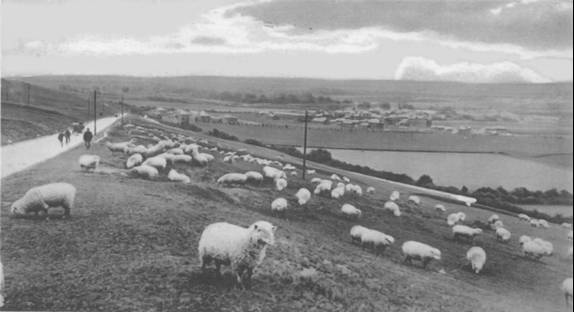
From medieval times until the 1940's large flocks of sheep
were kept on the hill. Grazing livestock produced a distinctive
open grassland rich in specialised plants that can cope with the
free-draining, nutrient-poor soil. Agriculture was clearly
important as there were several medieval villages on Portsdown.
To the north the villages have either disappeared or are
represented by a single farm. To the south villages have been
incorporated into urban Portsmouth. William Cobbett, 1763-1835,
in his famous book Rural Rides comments that some of the
earliest and finest corn in the whole of England was grown at the
bottom of the hill for many years.
As well as farming there are other reasons why early inhabitants
of the area would have preferred to occupy Portsdown Hill. Its
slopes form an important defensive barrier and lookout point. It
is thought that Roman, Saxon and Norman inhabitants took account
of the hill's strategic value.
The hill also provided a safe all-year route through the area
even when tracks through the surrounding countryside were
impassable due to waterlogging or the fear of attack. It is
likely that important routes ran the length of the hill, and from
early times these would have encouraged people to settle in the
area.
Sight-seeing from the hill is nothing new, and it has inspired at
least one poem. Here is the start of a lengthy poem by
J.W.Wakely, written in 1840 and dedicated to Sir George Staunton.
Italics are used in the original as shown here.
Hail fresh'ning eve! now heats intense decay,
To Portsdown Hill I rove - there to portray
The lovely scene expanding wide around,
The woods, the lawns, the rich enamel'd ground;
The distant hills their azure summits rise
From neighbouring vales, and sweep the circling skies;
The silvan beauties of the rural scene;
The vast outspreading of the deep serene;
Whilst thro' the Crab the radiant sun is roll'd,
And whilst the scene is ting'd with ev'ning gold.
For the full work, see "A poem on Portsdown Hill" in Portsmouth Central Library, ref. 821.WAK.
The picture shows sheep grazing in 1910, alongside Southwick Hill Road
From Forts to Follies
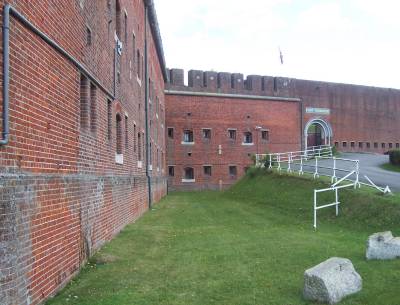
The defensive value of the hill was recognised by the
Victorians when they built the line of forts along its ridge in
the 1860's. Napoleon III had built up a strong navy, provoking
exaggerated fears of invasion. If an invader had landed elsewhere
along the coast and gained control of the hill, he could bombard
ships and buildings in Portsmouth Dockyard, so the forts were
built to resist attack from inland. But by the time the forts
were finished, the threat from France had disappeared, leading to
them being described as Palmerston's Follies, after their main
advocate Lord Palmerston.
A front view of Fort Purbrook, now used as the Peter Ashley Activities Centre.
Sadly the construction of the forts destroyed or buried earlier archaeological evidence, while leaving us with some impressive buildings suitable for a wide variety of activities.
The Fall and Rise of Grazing
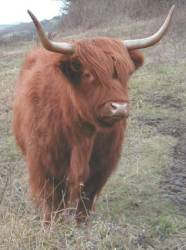
Cattle and sheep grazing had died out by 1960, leading to the invasion of the hill not by the French but by coarse grass, scrub and eventually trees. Rabbits would have had a significant effect on keeping the grassland short, but were devastated by Myxomatosis between 1953 and 1955. By the late 1980s it was clear that serious action was required to save the open nature of the hill, leading to the formation of the Portsdown Hill Countryside Project with the appointment of David Cessford as a full-time officer. Scrub control started on a small scale, and grazing was re-introduced. Highland cattle (pictured) are one of many breeds which have done their bit. Horses are used regularly, but the goats were rather too difficult to control in large areas, and attracted too much attention from some local people. Goats are presently being used with great effect to control scrub within the confines of one of the forts. Rabbits have re-established themselves and now have a major effect on the appearance of the hill. The story continues....