

Conservation Management
 Portsdown Hill overlooks to the south the populous city
of Portsmouth and its associated harbours. To the north are views
over the Forest of Bere to the South Downs. It is a small but
beautiful stretch of calcareous grassland much of which is
designated a SSSI (Site of Special Scientific Interest).
It is a pocket of rich but now uncommon biodiversity, containing
thousands of species. The vegetation is well adapted to the
free-draining, low-nutrient habitat that develops on chalk
outcrops subjected to long term grazing. There's a great variety
of plants, gives rise to an even greater variety of
invertebrates. Many species of insect benefit from the warm south
facing aspect of the hill. However, about 95% of chalk grassland
in this country has been lost to development and agricultural
improvement, so it is increasingly important to protect and
maintain what is left.
Some claim that "nature knows best" and the site ought to be left
with no interference and to allow the natural ecology to
regenerate. Left unmanaged scrub would continue invade the
grassland and the scrub would in turn be invaded by woodland. The
habitat produced would not only exclude the chalk grassland
species but would also render the site inaccessible. Furthermore,
it supports fewer species and it is relatively easy to create
elsewhere. Chalk grassland on the other hand take many decades to
develop and has been on the site for many hundreds of years.
There is a historical precedent for its retention. The wildlife
associated with the scrub habitat, e.g. birds and bush crickets,
can be retained in smaller scrub blocks to form a mosaic of
grassland and bushes.
Until the 1950's, the south face of hill was regularly grazed, producing a landscape dominated by grassland in which patches of scrub would have expanded and contracted as grazing pressure increased and decreased over the decades. With the decline of grazing, coarse grasses and scrub rapidly took over. The south face of the hill is now a patchwork of chalk-quarries, woodland, scrub, and grassland.
Since 1994, a concerted effort has been made to expand the grassland to its earlier dominance. A grazing programme was initiated which has required much fence-building, as well as scrub clearance, by both hand and machinery.
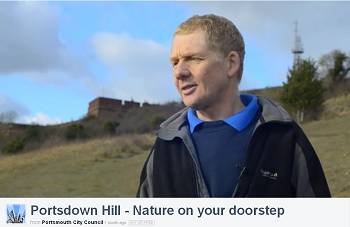
A short film
In 2013 a keen local film-maker produced a video about Portsdown Hill and its management. Some details are now a bit dated. Click on the image.
Scrub clearance

For many centuries, Portsdown was covered mainly in chalk grassland, with small pockets of scrub. Scrub was restrained by domestic grazing, which had doubtlessly been practiced on Portsdown since at least the Middle Ages. However, in the 1950's domestic grazing finally stopped as farming methods changed and the rabbit population died out due to myxomatosis. Until the early 1990's the site was effectively abandoned. In those few decades, scrub cover increased from pockets covering around 5% to nearer 70%. The remaining grassland was dominated by coarse grass species and the flower rich turf occupied only 5%. The aim is to change the the proportions of grassland and scrub, to get around 70% grassland and 30% scrub with other vegetation. In all its shapes and sizes, scrub provides habitats for a host of mini-beasts. Exposed to the Solent and prevailing south-westerly winds, Portsdown Hill is often a windy place. Tall bushes help to break up the wind, providing nest sites for birds and shelter for butterflies and other insects.
An enthusiastic team of volunteers, using hand-tools and brush-cutters are often engaged in keeping scrub under control, with the help of various items of powerful machinery.
Cotoneaster
There is a worrying amount of Cotoneaster, of various species, on the south side of the hill. It is not native to chalk downland but is capable of spreading easily by seed. Volunteers are engaged in controlling it either by digging it up or by cutting it down to ground level, hopefully without knocking too many berries off. This issue illustrates a typical conservation dilemma, since the variety of species attracts the interest of botanists keen to record invasive plants.
Hedges
There is little evidence of old hedges on the south side of Portsdown Hill. Early photos tend to show wide open landscapes with scattered bushes and only an occasional hedge line. Sheep were looked after in what would now be seen as a very labour-intensive way. To maintain the hill with grazing animals now requires division into compartments using barbed wire fences. These can be unsightly and prone to vandalise, so it is tempting to allow the scrub to grow up around them, but with the risk of making future inspection and maintenance more difficult.
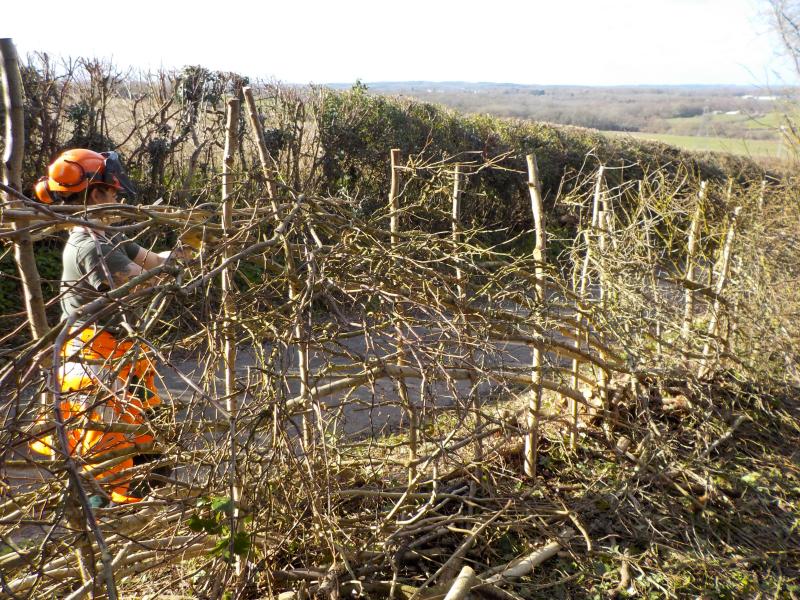
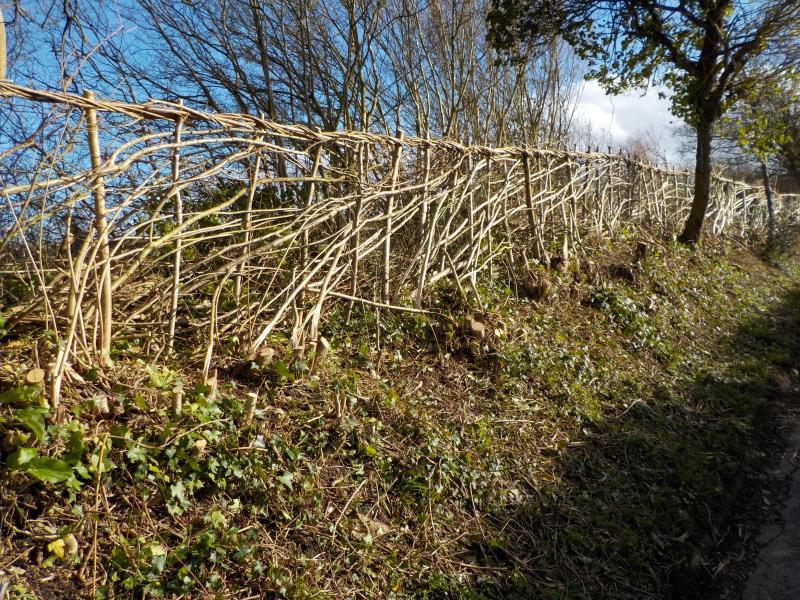 Part of the long hedge down Mill Lane has been laid. Laying revitalises the hedge, preventing it becoming a row of gappy trees and maintaining a variety of habitats for wildlife. There are various styles of hedgelaying, this is the most commonly-seen variety. Twisted binders along the top give an attractive finish.
Grazing
In post-glacial times, from 8,500 years ago Britain would have been grazed by the now-extinct aurochs, tarpan (wild horses), deer, hare and other wild grazers. To what extent these herbivores would kept have the woodland at bay is a matter of conjecture. It is clear that 5,000 years ago Neolithic settlers would have preferentially cleared trees on sites such as Portsdown Hill and introduced agriculture, including grazing livestock. Subsequent cultures would have continued this process to produce the extensive grassland found in the middle ages. So from at least the Middle Ages until the mid-1950's, domesticated sheep and other livestock kept the hill open, either 'in situ' or en route to Portsmouth, from where wool and meat has been exported for centuries. Many local people still remember Portsdown as an open, grassy area, with some pockets of scrub.
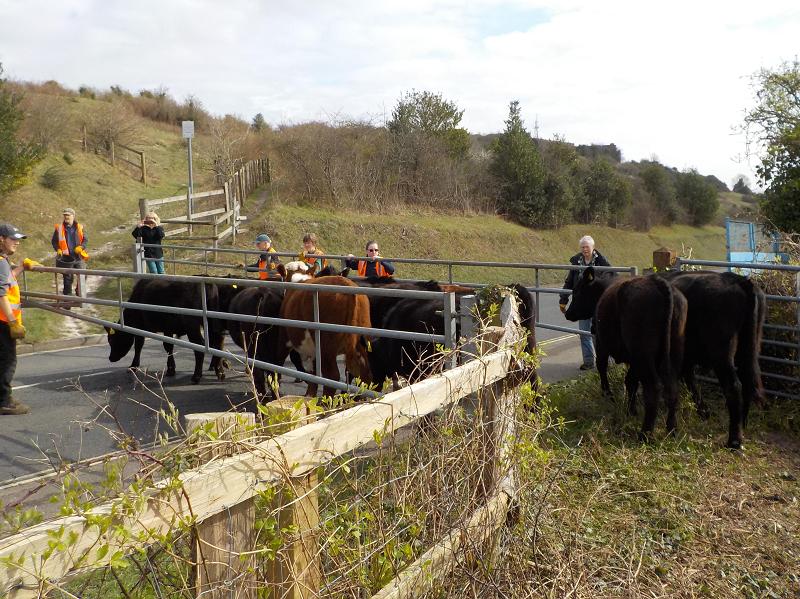 Since the middle of 1990s, 'conservation grazing' on the site over most winters has been introduced and increased in extent. Cattle have been borrowed from both conservation herds and local farmers. Horses, goats and sheep have been used, but cattle are now preferred. There's usually some tense moments and surprised motorists when the cattle are moved across Southwick Hill Road for a change of scenery. Grazing largely occurs in the winter, although it may extend into the growing season.
The Portsdown SSSI is divided into 11 'compartments', from its west-most extent at Porchester Common along to the area bounded by the A3 to the east. Compartments have been defined by fencing to allow a controllable level of grazing. See John Goodspeed's page for descriptions of the compartments.
Fences and gates

There is about 12 km of fencing, along with numerous water troughs and holding pens. Over forty access features such as field gates, kissing gates, stiles and squeeze points have been fitted. Stiles are relatively cheap and easy to install, but are not very user-friendly so they are gradually being replaced with kissing gates. The one pictured is near Cliffdale Gardens. On the slope above it you may find a rare plant called Bastard Toadflax, Thesium humifusum, in the short turf. Five posts are needed for the gate and its surround, plus two straining posts for the ends of the fence. Although chalk is a relatively soft rock, it is pretty unforgiving to dig into. The monthly Sunday team did most of this over three sessions. Tempting though it seems, it is generally not a good idea to attach other structures to a fence post, as unexpected problems can arise. Sweet Chestnut was used for the gate posts.

 Fence posts and other timber for the
construction of estate furniture often comes from softwood
plantations. They are felled, shaped, and treated with
preservatives (tanalised) and then transported a considerable
distance. On Portsdown, a different, more sustainable, approach
has been tried, to reduce the potential environmental impact of
the preservatives and the transport-derived carbon footprint.
Starting in 2003, locally grown Holm Oak was tried as an
alternative fencing timber. Holm Oak grows on site but is an
invasive species. It is much harder than the softwood
alternative, and it was hoped that it would be at least as
durable. Unfortunately, it has not stood the test of time,
lasting only about five years in some places. To quote Richard
Jones, "they rot out quicker than wet newspaper". The upside is
the benefit of a rich, varied and diverse fungal and invertebrate
life while the post is rotting away. Many old posts are being
left in place, with a new, treated replacement alongside.

Life in old posts
An Ichneumon fly was spotted laying eggs into a Holm Oak post. This is actually a parasitic wasp rather than a fly, and uses its sensitive antennna to detect a host for the egg to develop in. The unfortunate target may be the larva of a moth, or perhaps a beetle grub. Either way it means that the post is already home to some wildlife.
Machinery Usage


While cattle and volunteer labour are central to sustainable
management, the realistic restoration of extensive grassland
requires some mechanical assistance.
Between July 2003 and April 2004, new machinery was purchased
with grants from English Nature and Onyx via the 'landfill tax'
scheme. This equipment has accelerated scrub-clearance since the
flail on the all-terrain tractor can clear a great deal more
scrub than volunteers armed with billhooks. The collector unit
(right) can be towed and powered by the tractor and enables us to
cut and remove the inevitable regrowth on all but the trickiest
of slopes.

A four-wheel drive tractor with front bucket is handy for collecting up piles of cut scrub or wood, and is also rather good at plucking whole bushes straight out of the ground, something you could never do by hand.
However, there is still plenty of manual work to be done. Trenches and other steep terrain are not accessible by machinery, or "we can get it down the slope, but not up again". Furthermore, some close work is still best done with hand-tools and more discriminating workers. Rare plants, nesting birds and dumped motor-bikes may be recognised by human workers, but not by the machinery.